


Introduction: Ghosts of Industry Past


The ghosts of American manufacturing cast long shadows across the Southeast. Drive through most of the small towns nestled in the Appalachian foothills or meandering along southeastern valleys, and you'll find them: hulking brick factories with shattered windows, vacant parking lots where thousands of workers once changed shifts, and water towers bearing faded company names that once defined entire communities. These are not mere abandoned buildings—they are monuments to an era when manufacturing was the backbone of America's middle class and the foundation of countless small-town economies. From the Carolinas' mills that once produced 60% of America's furniture to Birmingham's steel furnaces that earned it the title "Pittsburgh of the South," these sites tell the story of a region that once dominated American manufacturing.
But these industrial graveyards might be on the cusp of an unexpected resurrection. In a twist of historical irony, the region's industrial heritage—from abandoned lithium mines near Charlotte that once supplied the Manhattan Project to the extensive rail networks built for textile and steel transport—could provide the foundation for America's next industrial wave.
As the Southeast emerges as America's new "Battery Belt," with Georgia leading the nation in clean energy investments ($17 billion), followed by South Carolina ($9.3 billion), these dormant industrial sites could find new purpose.
The region's infrastructure and lower costs make it ideal for this transformation, where skilled technicians will oversee advanced robotics. From mineral mining to battery production, the Southeast can build an integrated manufacturing network.
With global supply chains shifting and clean energy demand rising, the Southeast has a unique opportunity to reimagine manufacturing through automation and innovation, turning old industrial towns into modern technology hubs.
This represents the region's next industrial revolution - one powered by AI and advanced manufacturing.
Birth of the Industrial South
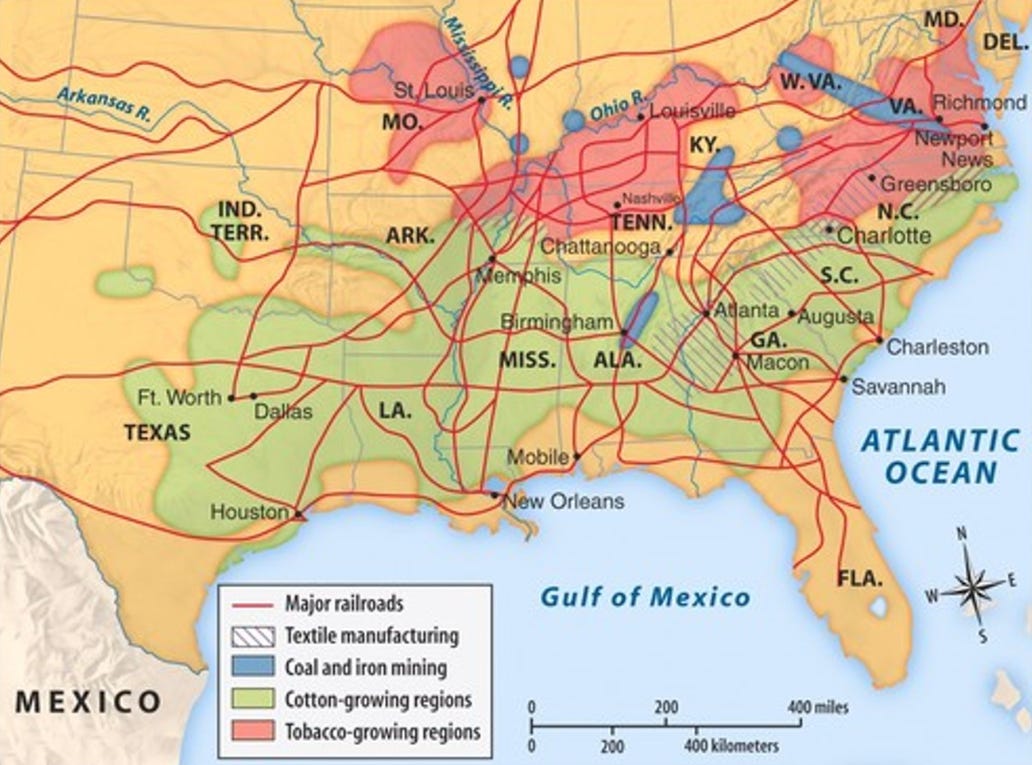
The transformation of the American South from an agricultural economy to an industrial powerhouse began after the Civil War, marking the start of what is known as the "New South" era. By the 1880s, the region’s abundant natural resources—ranging from extensive cotton fields and timber forests to rich deposits of coal and iron ore—combined with a large workforce and expanding railroad networks, creating ideal conditions for industrialization. This transformation relied on four key industrial sectors: textiles, steel, furniture, and tobacco, each significantly influencing specific geographic areas and shaping their respective communities for generations.
The scale of this industrial revolution was remarkable. The textile industry centered in the Carolinas; by 1900, South Carolina had become the second-largest cotton-textile-producing state in the United States, following Massachusetts. Birmingham emerged as "the Pittsburgh of the South," utilizing its unique geological advantage of having all three raw materials needed for steel production within a 30-mile radius, eventually producing 25% of the nation’s foundry iron. High Point, North Carolina, became known as the "Furniture Capital of the World," generating 60% of U.S. furniture within a 150-mile radius during its peak. The coal mining industry in the Appalachian region (West Virginia, Virginia, and Tennessee) experienced similar growth, increasing production from 133,000 tons in 1870 to 7 million tons by 1910, fundamentally reshaping mountain communities through the establishment of company towns and industrial development. This golden age of Southern manufacturing represented more than just economic statistics; it signified a profound change in Southern society, shifting from a rural agricultural focus to an urban industrial one. New social classes emerged, communities reorganized around different products, and cultural patterns evolved as the region embraced industrialization. Company towns, built around textile mills, coal mines, or furniture factories, established new hierarchies and lifestyles that would define the region for generations. While this transformation brought unprecedented economic growth and development, it also came with significant social and environmental costs that continue to affect the Southeast today.
The Great Decline (1970s-2000s)
The exodus of American manufacturing from the 1970s to 2000s resulted from several converging factors that fundamentally changed the economics of domestic production. Major trade policy shifts, particularly NAFTA enactment in 1994 and China's WTO entry (2001), removed protective barriers that had previously sheltered U.S. manufacturers from international competition. These changes exposed the stark reality of labor cost differentials, where U.S. wages were often 3-6 times higher than Asian competitors. This wage gap and rising healthcare and pension costs in the U.S. made overseas production increasingly attractive to corporations. American companies initially formed partnerships with foreign manufacturers, but this eventually led to wholesale knowledge transfer and transition to overseas production.
Simultaneously, U.S. manufacturers faced mounting challenges at home: aging infrastructure required costly upgrades, environmental regulations imposed new compliance costs, and energy efficiency lagged behind modern foreign facilities. Government policies further accelerated this trend through tax structures that often favored overseas production and a lack of comprehensive industrial policy to support domestic manufacturing. This combination of external pressures and internal challenges created a perfect storm that drove many companies to shift production overseas, fundamentally restructuring the American manufacturing landscape.
Seeds of Revival
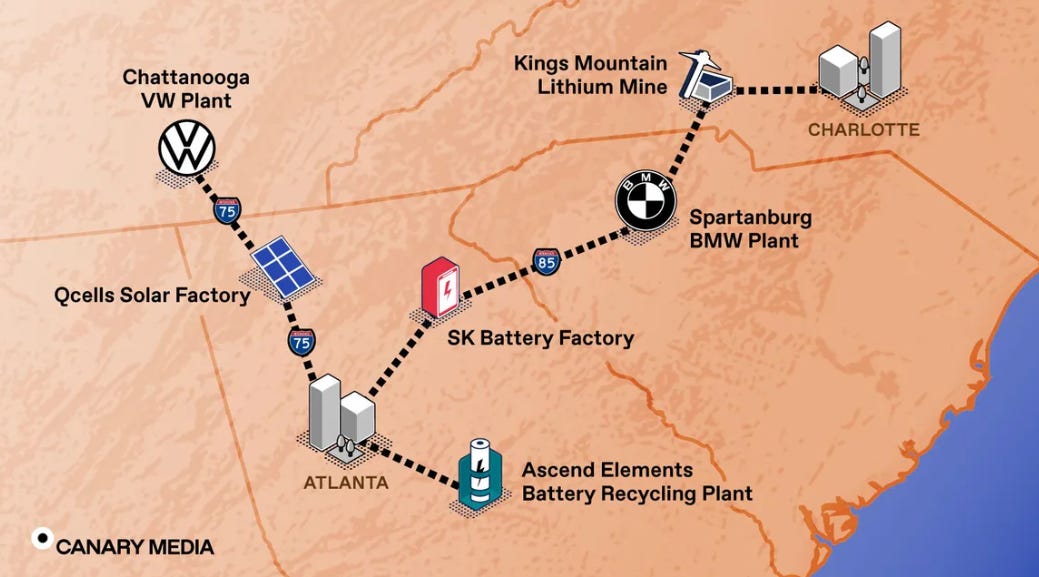
The Southeast is experiencing a manufacturing renaissance, anchored by massive investments in electric vehicle and battery production that are creating a new "Battery Belt" across the region. Georgia leads the country in post-IRA clean energy factory investments with over $17 billion, followed by South Carolina with $9.3 billion. The scale of job creation is equally impressive: SK Battery America alone employs 2,600 workers in Georgia, with plans to reach 3,000 by year's end, making it one of the state's largest single-site employers. Major projects like Ford's $5.6B Blue Oval City in Tennessee, Hyundai's $5.54B EV plant in Georgia, and VinFast's $4B facility, with projected employment reaching 40,000+ direct jobs by 2025 and an additional 100,000+ supplier and support jobs.
While electric vehicles anchor this transformation, the clean manufacturing revolution spans multiple sectors. In solar energy, Q Cells is investing $2.5B in Georgia with 2,500 new jobs, while First Solar is developing a $1.1B facility in Alabama creating 700 jobs. Simultaneously, the wind energy component manufacturing sector is expanding through facilities like GE Renewable Energy in South Carolina, CS Wind in Virginia, and Siemens Gamesa establishing facilities in North Carolina. Supporting this manufacturing boom, Georgia's Vogtle Electric Generating Plant has achieved a historic milestone by helping push clean energy generation above fossil fuels for the first time in state history.
Completing the clean energy ecosystem is a growing battery recycling sector. Ascend Elements opening in Georgia and Redwood Materials investing $3.5B near Charleston are leading this charge, with plans to process materials for approximately 1 million electric vehicles annually by 2025. These recycling operations are fostering a circular economy, exemplified by Ascend Elements' $1B deal to supply recycled materials to U.S. battery manufacturers.
The region's manufacturing diversity extends to aerospace and defense, with Boeing's 787 production in Charleston and Airbus's A320 assembly operations in Mobile serving as cornerstones of this sector.
Supporting this industrial expansion, regional institutions like Georgia Tech's Pilot Facility and Clemson's $130M Advanced Manufacturing Complex, are preparing workers for this future, while innovation districts emerge around these facilities.
This manufacturing revolution represents a fundamental shift rippling through the entire supply chain. As traditional automotive suppliers pivot to serve EV production, new specialized suppliers are emerging to support battery and clean energy component manufacturing. The Southeast's strategic advantages - including lower operating costs, robust transportation infrastructure, and business-friendly policies - are positioning itself as the epicenter of America's clean manufacturing revolution.
The Path Forward


Manufacturing is gradually returning to the Southeast, though at a significant cost through state and federal incentives. While advanced robotics and AI could accelerate this trend, fundamental challenges remain: high labor costs, geopolitical tensions, and outdated regulatory frameworks must be addressed before manufacturing can approach its former peak.
Former industrial sites can become advanced facilities where AI-guided robots work alongside skilled technicians. Though employing fewer workers directly, these automated facilities can stimulate broader economic growth through increased demand for services and suppliers within the community. Drawing on its history of industrial adaptation, the Southeast can leverage its traditional advantages to reduce foreign manufacturing dependence. Success, however, requires more than innovation – it demands coordinated policy efforts, workforce development, and strategic infrastructure investment to compete in an increasingly complex global landscape.